PatternsFoundry

Computational Science.
Complex Systems.
Institutional Futures.
Products and Innovations.

PatternsFoundry is an independent knowledge and innovation platform exploring the interactions between people, technology, institutions, and markets. It brings together research, product thinking, computational methods, open knowledge, and collaborative experimentation to understand complex problems and develop practical solutions.

THINKRESEARCHBUILDSHARE
Socio-technical systemsConceptual illustration

People use technologies, participate in organisations and shape institutional practice.

More than two decades across enterprise technology, product management,
entrepreneurship and higher education leadership.
India · International engagements

Latest from PatternsFoundry

New ideas, research, products, experiments and discoveries from across the Foundry.

Explore the archive
01 / Expertise

Experience and inquiry.

PatternsFoundry connects research, technology and innovation to help people understand complex systems, make better decisions and build effective solutions. Researchers can discover new questions, methods and opportunities for collaboration; policymakers can explore evidence-based frameworks for governance and institutional change; industry leaders can identify emerging technological opportunities and strategies for innovation; and innovators can engage with ideas, models and experiments to develop practical solutions. Through original research, publications, computational models, open knowledge and collaborative projects, PatternsFoundry transforms insights into actionable knowledge, partnerships and innovations for more intelligent, adaptive and resilient systems.

Experience and inquiry
Computational Science and Multi-Agent SystemsAI Governance and Public SystemsTechnology Strategy and InnovationInstitutional Leadership and Capability BuildingHow do interactions produce collective outcomes?Trace these interactions and explore emergent outcomes.
01

Computational Science and Multi-Agent Systems

Research into self-organising multi-agent systems, complex adaptive behaviour, agent-based modelling and emerging agentic AI systems.

02

AI Governance and Public Systems

Institutional design, technology governance and digital public infrastructure, with an interest in computational approaches to public decisions.

03

Technology Strategy and Innovation

Enterprise technology, product management and platform ecosystems, grounded in experience with co-innovation, entrepreneurship and innovation programmes.

04

Institutional Leadership and Capability Building

Academic programmes, interdisciplinary teams, innovation ecosystems and partnerships that support learning and institutional capability.

02 / Selected work

Work across institutions,
research and society.

Selected professional initiatives and research in progress. Each is identified by its current stage.

Published perspectives

Writing & published articles.

Substack

The Systems Lens

Essays by Aditya Trivedi on systems, society, technology and public life.

03 / Research

Research Directions

Computational science and complex systems provide the wider context for inquiry into behaviour, technology and institutions.

A socio-technical systems perspective
PeopleTechnologyOrganisationsInstitutionsSocio-Technical Systems
Self-Organising Multi-Agent Systems (SOMAS)

Computational investigation of interactions, coordination, emergence and collective behaviour.

Digital Anthropology for Socio-Technical Systems

Empirical and situated investigation of lived experiences, practices, cultural meanings and technology-mediated behaviour.

Research directory & resources

Application

Applied Food Systems Research

How do ultra-processed food habits spread in urban India?

Show moreShow less

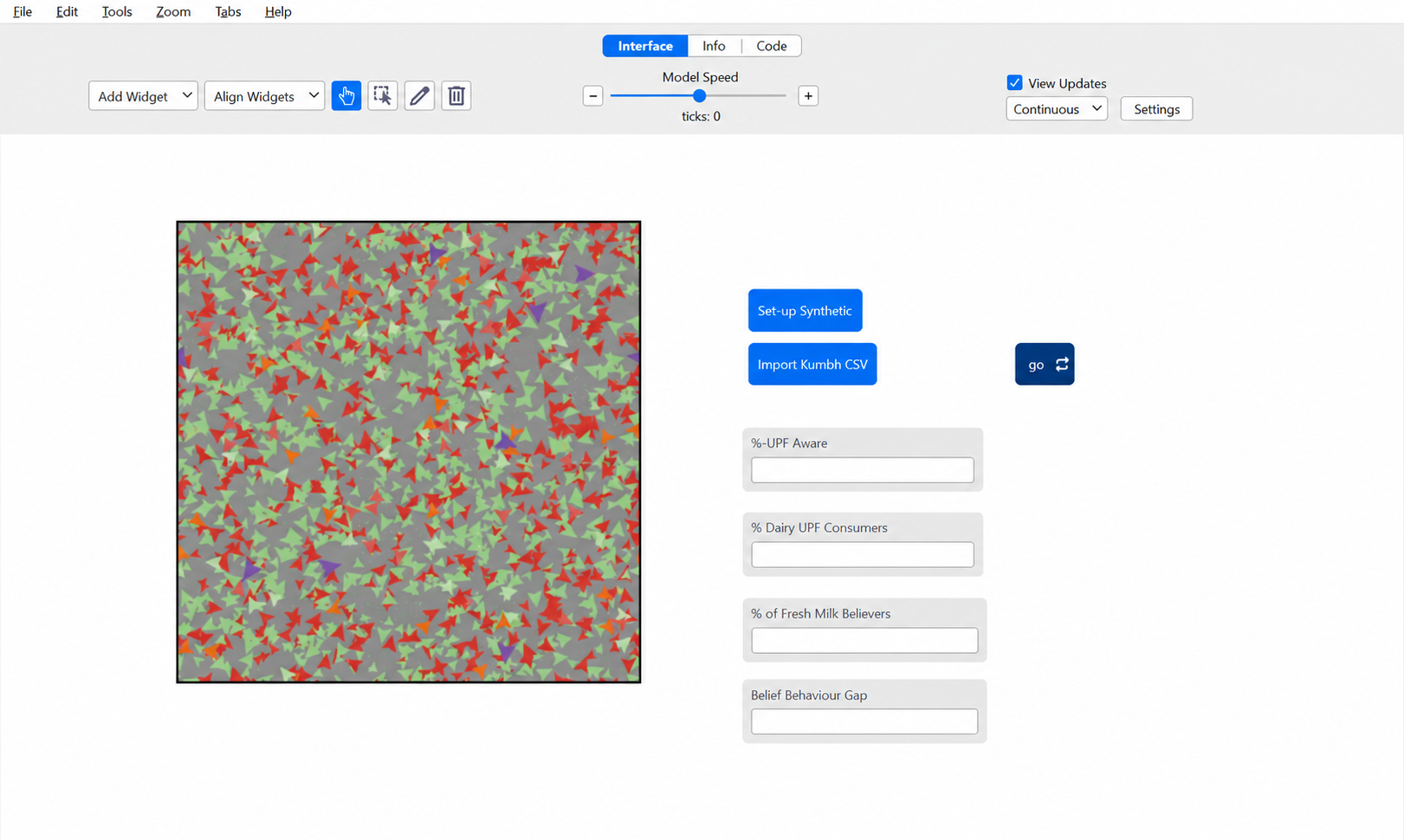
The ongoing doctoral research examines the diffusion of ultra-processed food consumption in urban India, with Indore as the primary case. It provides an empirical application of the wider inquiry into social influence, digital platforms, human behaviour and computational modelling of complex socio-technical systems.

Doctoral research, independently developed ideas and joint work retain their distinct scope.

Bringing systems questions into social computation

Aditya Trivedi and Prof. K. Gopinath

Our research explores how computational thinking can illuminate complex social problems. Self-organising multi-agent systems provide a central direction: modelling how agents interact, how norms and institutions shape coordination, and how collective behaviour changes over time. These ideas are being developed through modelling and empirical inquiry.

Conceptual exampleHow might a new food habit spread through a neighbourhood?
Models & evidenceWhat would count as a change in habit?
Coordination & constraintsHow might peers and local shops shape choices?
Computation & cultureWhat makes a food familiar or acceptable locally?
Collective behaviourWhich interactions could explain a neighbourhood pattern, and what evidence would distinguish competing explanations?
01 / MODELS & EVIDENCE

Make assumptions inspectable

Social simulations need explicit behavioural rules, observable outcomes and clear limits. A systems perspective encourages asking what a model represents, which properties can be checked, and where field evidence must constrain its conclusions.

02 / COORDINATION & CONSTRAINTS

Study the rules of interaction

Multi-agent research asks how local decisions generate collective outcomes. In our research, this becomes a question about institutional rules, platform incentives and resource constraints—and how alternative arrangements might change behaviour.

03 / COMPUTATION & CULTURE

Keep context inside the model

Digital anthropology and vernacular food knowledge bring cultural meaning into the research. The challenge is to translate lived categories into computational representations while retaining the distinctions that matter to people.

About / People and practice

Computational Science.
Complex Systems.
Institutional Futures.

From understanding to impact
  1. Meaning

    Understanding complexity

    Investigate how relationships, incentives, technologies, institutions and human behaviour shape collective outcomes in complex socio-technical systems.

  2. Approach

    Interdisciplinary and computational inquiry

    Combine computational science, Self-Organising Multi-Agent Systems (SOMAS), digital anthropology for socio-technical systems and empirical investigation to examine interactions, adaptation and emergence.

  3. Outcome

    Actionable insights and institutional futures

    The aim is to generate knowledge, explore and test interventions, and inform more adaptive technologies, better decisions and accountable institutions.

My work connects enterprise technology, innovation and institutional leadership with emerging research in computational science, multi-agent systems and AI governance. I am interested in how individuals, technologies and institutions interact to shape collective behaviour — and how better understanding these interactions can inform organisational strategy and public decisions.

Explore expertise, published perspectives, the research partnership, leadership and experience, and work at Rashtram.

Research partnership

Prof. K. Gopinath

Research & intellectual partner

Prof. Gopinath and I collaborate on research connecting computing, human behaviour and institutional design. Our intellectual partnership brings his depth in computer systems into dialogue with my experience in technology, public leadership and social research. He also serves as my doctoral research guide at Rishihood University.

A career across computing and ideas

Prof. Kanchi Gopinath is Senior Professor at Rishihood University. Previously, he served in Computer Science and Automation at the Indian Institute of Science, retiring in 2021 after 31 years, and headed the Computer Science and Artificial Intelligence programme at Plaksha University from 2021 to 2024.

His research encompasses operating and storage systems, security, privacy and verification, alongside applied AI and computational thinking in the Indic tradition.

Computer systemsVerificationSecurity & privacyApplied AIIndic computational thought

Academic formation

IIT MadrasB.Tech · 1977
University of Wisconsin–MadisonMS · 1980
Stanford UniversityPhD · 1988

His career also includes work at AMD and postdoctoral research at Stanford.

IISc academic homepage
Current Rishihood profile

Selected scholarship by Prof. Gopinath

Resource Proportional Software Design for Emerging Systems

Co-authored with Suparna Bhattacharya and Doug Voigt. Chapman & Hall/CRC, 2020.

Book and publication details

Security, privacy & public infrastructure

His publications include “Towards a more secure Aadhaar” (ICISS 2017, Best Paper) and “Analysis of Newer Aadhaar Privacy Models” (ICISS 2018), both with Ajinkya Rajput.

Explore the publication list

Profile sources: IISc academic homepage, IISc retirement announcement, and Rishihood University faculty profile. Reviewed October 2026.

04 / Leadership

Leadership & Experience

Experience across enterprise platforms, entrepreneurial ventures and educational institutions.

Senior Director, SAP Labs India

Earlier leadership role

Enterprise technology, cloud platform strategy, product management and co-innovation. Conceived and led the SAP–NASSCOM product-management learning series, reaching over 7,000 participants across 24 webinars.

Director, Rashtram School of Public Leadership

Former appointment · Rishihood University

Public leadership education, systems thinking and institutional programmes. Institutional laboratory work included establishing a Systems Thinking Lab and co-establishing a human-augmentation / Rekhi Mind lab, supported by funding totalling ₹75 lakh.

Programme Director, Rishihood Foundation Programme

Former appointment

Built and led a multidisciplinary programme serving 750+ learners, assembling a 23-member delivery team. Explore the Foundation Programme.

Founder & CEO, Baelworks Innovations

October 2020 – January 2024

Entrepreneurial innovation and product development. Led a team delivering more than 20 pilots and MVPs across cybersecurity, retail, logistics, agriculture and education.

Founder, Bharosa AgriInnovations

December 2021 – January 2024

Agriculture and rural enterprise innovation, involving field stakeholders, technology adoption and agro-MSME development.

CEO, Avantika Innovation & Incubation Center

2022 – 2023

Incubation processes, startup pipelines and institutional partnerships, alongside teaching in design, user experience and entrepreneurship.

International & public-sector engagements

Selected consulting and educational work

Led a consulting pilot for Bhutan’s national skilling initiatives under His Majesty’s Secretariat. Public-sector educational work included support for Haryana’s Chief Minister’s Good Governance Associates learning programme.

Download executive résumé (PDF)
Open Commons

Knowledge to build upon.

A space for documented models, reusable knowledge and future open resources. The public model card is available to read; data, code and API releases will be listed only when ready.

Continuing inquiry

Questions worth working on.

Conversations

Conversations & Collaborations

I welcome conversations with institutions and organisations working on consequential problems involving technology, complex systems, research and institutional transformation.

Product thinking & innovation

Product strategy and discovery connect human-centred design, behavioural insight and technology development. The work here spans adoption, platform ecosystems, institutional innovation and public-interest technology.

Explore the experience behind the work.

Product case studies, notes and perspectives
  • Senior leadership and institutional appointments
  • Research collaborations and fellowships
  • Strategic advisory and consulting
  • Interdisciplinary programmes and research initiatives
  • Lectures, seminars and invited discussions
aditya@patternsfoundry.org