Consumers
Individuals differ in their circumstances, beliefs, access and consumption practices. Awareness and behaviour are treated as distinct.
A conceptual overview of an agent-based research model of social diffusion. Ultra-processed food consumption is the doctoral research application; the wider interest is collective behaviour in complex social systems.
Technical paper in preparationHow do social interaction, differences in everyday circumstances and digitally mediated influence shape the diffusion of consumption practices—and the distance between what people believe and what they do?
The intended generalizable contribution to self-organising multi-agent systems (SOMAS) research is to examine how local interactions can generate population-level patterns without a single coordinating controller. The ambition is to inform inquiry into other social and institutional settings. Transferability remains to be tested; it is not an established result.
This public description states the conceptual roles and relationships, without specifying implementation rules, parameters or data records.
Individuals differ in their circumstances, beliefs, access and consumption practices. Awareness and behaviour are treated as distinct.
Social contacts and digital voices provide exposure to practices and information. Their relevance may differ between individuals.
Local availability and the surrounding commercial environment shape the options people encounter.
Individuals encounter social and commercial signals, may revise beliefs, and may change behaviour subject to their circumstances. Repeated local interactions generate aggregate diffusion patterns. Platform and policy conditions provide the wider setting; this card does not claim every institution is implemented as a separate agent.
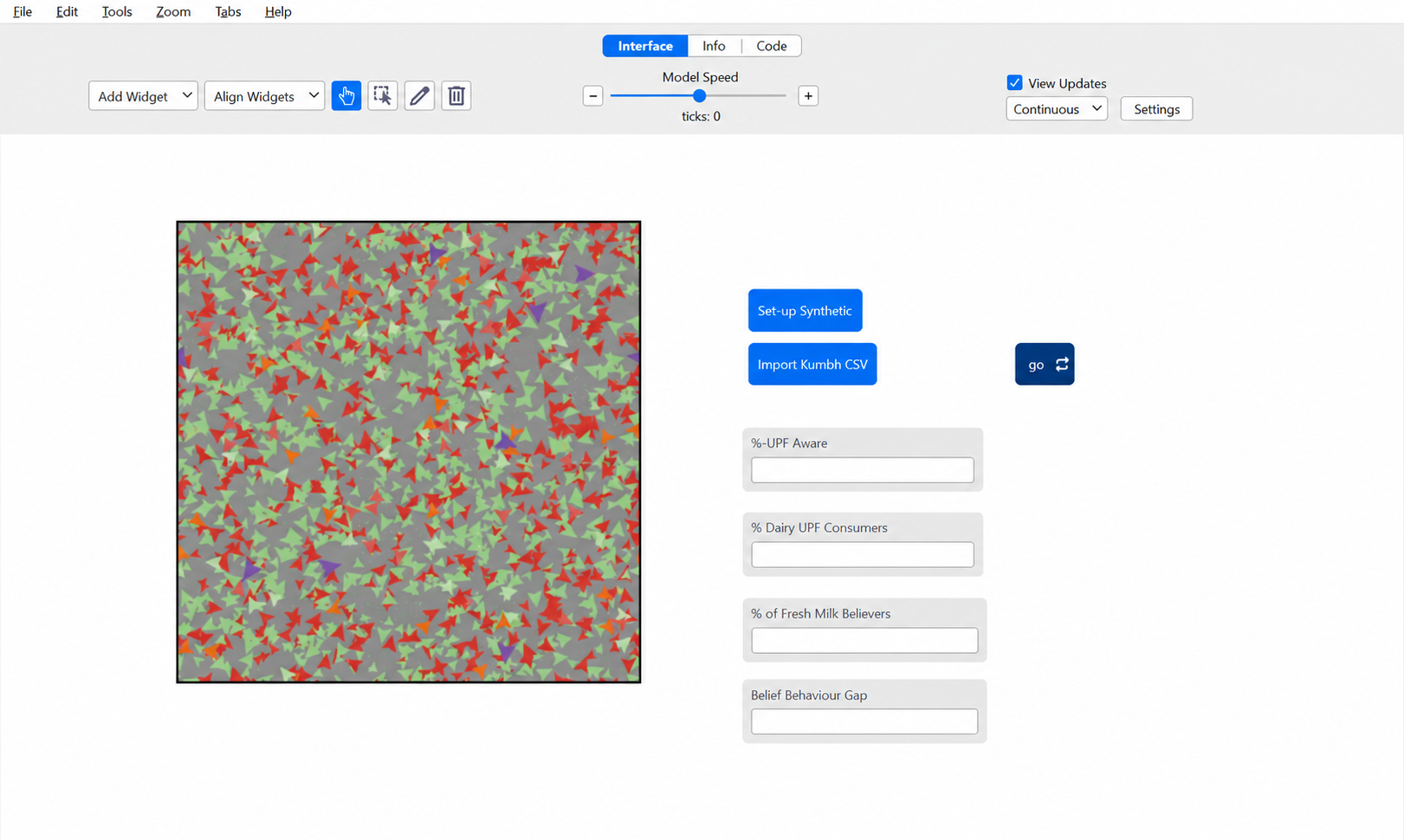
The screenshot source is the Kumbh application. Generalisation to urban settings, including Indore, remains part of the wider research agenda.
These are the non-sensitive outputs to report. No numerical results or empirical performance claims are presented here.
The proportion of agents adopting a focal practice over simulation time, showing the pace and extent of diffusion.
The divergence between agents’ stated awareness or beliefs and their simulated consumption behaviour. The operational definition will be documented in the technical paper.
Differences in adoption and belief–behaviour patterns across settlement contexts represented in a model run. Group labels and comparability require explicit definition.
Differences in simulated outcomes across digital-exposure conditions. Such comparisons describe model scenarios, not an identified real-world causal effect.
Technical paper in preparation. This is a public overview of work in development, not a peer-reviewed publication, validated forecasting tool or policy recommendation.
Aditya Trivedi · Doctoral research with Prof. K. Gopinath.
aditya@patternsfoundry.org